
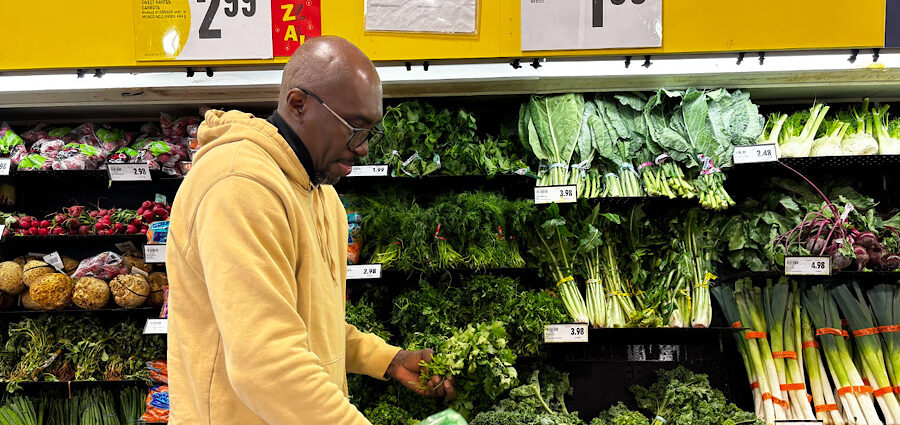

A THORNCLIFFE PARK RESIDENT SHOPS FOR GROCERIES AT FOOD BASICS IN THE EAST YORK TOWN CENTRE. Yara El Murr, Local Journalism Initiative Reporter, The Green Line
By Yara El Murr, Local Journalism Initiative Reporter, The Green Line
August 3, 2026
Do you live in a food desert or food mirage in Toronto?
That’s an area, usually in low-income neighbourhoods, where nutritious food sources are hard to find or where healthy food options are really expensive.
Researchers from the University of Waterloo recently identified346 food deserts and 155 food mirages in Toronto. That means 19% of all Torontonians live in a food desert or mirage. Most of them are around Scarborough, Etobicoke and North York, and encompass Neighbourhood Improvement Areas (NIA).
Flemingdon Park, a North York neighbourhood of around 22,000 people, is one of them — and that’s no surprise.
It has just one supermarket, Sunny Foodmart, in addition to a Shoppers Drug Mart and a convenience store. Residents also have the option of shopping in neighbouring Thorncliffe Park and Don Mills, which have Costco, FoodBasics and C&C Supermarket.

Locals in Flemingdon Park and Thorncliffe Park have been struggling with food insecurity for a long time. Along with housing, it’s one of the top two concerns that staff at The Neighbourhood Organization (TNO) in Thorncliffe Park hear from residents seeking services.
Last year, the TNO Food Collaborative served 3,033 local households — nearly three times the number of households served in 2021. In 2024, a research group called Flemingdon and Thorncliffe Food Justice published a study on food access in the neighbourhood that said, “Food insecurity is increasing in prevalence and deepening in severity.”
Even 10 years ago, a study conducted by Flemingdon Health Centre found that 76% of the Flemingdon Park residents interviewed felt they couldn’t find the food items they needed to stay healthy. In both Flemingdon and Thorncliffe, half of the participants shared that even if the food they needed was available, they couldn’t afford it after all of their regular monthly expenses had been paid.
But it’s not just the price tag. Multiple residents told The Green Line that the produce they find at grocery stores are of poor quality.


“I realized when I was shopping in Thorncliffe — this is like a really long time ago, like 12, 13, 14 years ago — there was no access to locally grown food, and there definitely was no access to organic food. So, I thought that was a little bit of an injustice,” says resident Michelle Delaney, who also founded Thorncliffe Park Urban Farmers, a grassroots group that grows its own produce.
Today, there are more options in Thorncliffe; residents can shop at Longo’s, Costco, Food Basics, Farm Boy or Iqbal Halal Foods, for example. But Delaney, as well as other locals and shoppers interviewed by The Green Line, say it’s still hard to balance affordability and quality. They often have to sacrifice one for the other.
SO, WHERE DOES OUR PRODUCE COME FROM?
If you rely on big supermarket chains to tell you…you might not always get a straight answer. In the Food Basics in Thorncliffe Park, a stack of hothouse red tomatoes was marked as from “Canada or Mexico and/or USA.”
Even food and agriculture experts say it’s hard to tell exactly how much of the produce we eat comes from our immediate surroundings.
Overall, about half of all Canada’s fruits and veggies are imported from the U.S. In 2024, in Ontario, we imported $41.1 million worth of agricultural food products — an amount that’s been steadily increasing since the 1990s.
Locally in our province, there are over 3,500 fruit and vegetable growers. According to the Ontario Fruit and Vegetable Growers Association (OFVGA), these growers produce over 125 different fruit and vegetable crops, with an estimated annual value of more than $3.63 billion.
But local farmers can’t compete with the price of imported goods. Canadian farmers also face challenges in selling their produce directly to local consumers for many reasons, including regulations and red tape, as well as a lack of resources or interest in selling locally, according to Statistics Canada.
Why does it matter where our food comes from and where we buy it?
When food is imported, what’s on your supermarket shelf and how much it costs is closely tied to global events.
According to the 2026 Canada’s Food Price Report, Canada’s “trade war” with the U.S., tariffs and counter-tariffs increased grocery costs. In 2023, Russia’s invasion of Ukraine and supply chain disruptions contributed to hikes in food prices, according to Canada’s Competition Bureau. Beyond these conflicts, climate change’s impact on agriculture in Canada and in countries where we import food also affect the price of our groceries.

Other factors include big supermarket chains, which have been accused of “greedflation” or increasing prices to max out profits while shoppers struggle to afford groceries. That’s hard to prove or disprove, but you may have heard of well-documented cases of shrinkflation and skimpflation (i.e. keeping the same price tag for a slightly smaller quantity of food), as well as price gouging(i.e. increasing prices to unreasonable amounts during real or exaggerated emergencies and periods of shortage).
In Toronto, and across Canada, most grocery prices are dictated by three conglomerates that control roughly 75% of all food retail. Canadian parent companies own both premium supermarkets and their discount rivals; for instance, Loblaws owns No Frills, Sobeys owns FreshCo and Metro owns Food Basics). This “captive market” reduces the incentive to offer the lowest possible prices because there is less independent competition. Canada’s Competition Bureau published an extensive report on this topic in 2023.
In food deserts, the problem can be worse. “The fewer stores you have, the more likely you’ll see prices go up,” says Sylvain Charlebois, a researcher of food distribution and policy at Dalhousie University and co-author of Canada’s Food Price Report.
In this report, Charlebois and his colleagues found that the average family of four is expected to spend $17,571.79 (or half a full-time minimum wage income) on food in 2026 — an increase of almost $1,000 from last year. Food prices are 27% higher than they were five years ago, the researchers say.

FLZH Electric Food Processor – USB Rechargeable Mini Chopper (250ml) 🎉 Exclusive Deal: CA$0.71 | 👉 View Product Deal
This post contains affiliate links. We may earn a commission if you make a purchase through these links, at no extra cost to you.

According to the StatCan Consumer Price Index (CPI), which is Canada’s primary measure of inflation, as of March 2026, the 12-month grocery inflation rate is tracking at 4.4%. That’s significantly higher than the rate seen two years prior when it was only 1.4% in March 2024. This means that while prices were rising slowly in early 2024, the pace of price increases accelerated sharply over this past year.
Torontonians are feeling the impact. According to Daily Bread Food Bank’s Who’s Hungry Report 2025, food bank visits in Toronto reached 4.1 million last year — a 340% increase since before the pandemic and the highest ever recorded. More than one in 10 Torontonians now rely on food banks, compared to one in 20 just three years ago. What’s more, 71% of them are 44 and younger.
With this stark reality in mind, many grassroot groups and farmers across Toronto are growing their own food to share with friends, family and neighbourhood food banks, as well as to sell locally.
“We’re seeing so much instability in global trade. Just think about how disrupted people were when they couldn’t get toilet paper,” says Tara Ramkhelawan, a farm program coordinator with FoodShare. (If you need a refresher, read this Statistics Canada article about the great toilet paper scare of 2020.)
Subscribe to our newsletter.
“What about when we can’t get the food that we need?” she says. “So, it’s important that people have access to local ways to produce their own food.”
