

By Fern Marmont, Local Journalism Initiative Reporter, The Eastern Door
October 9, 2026
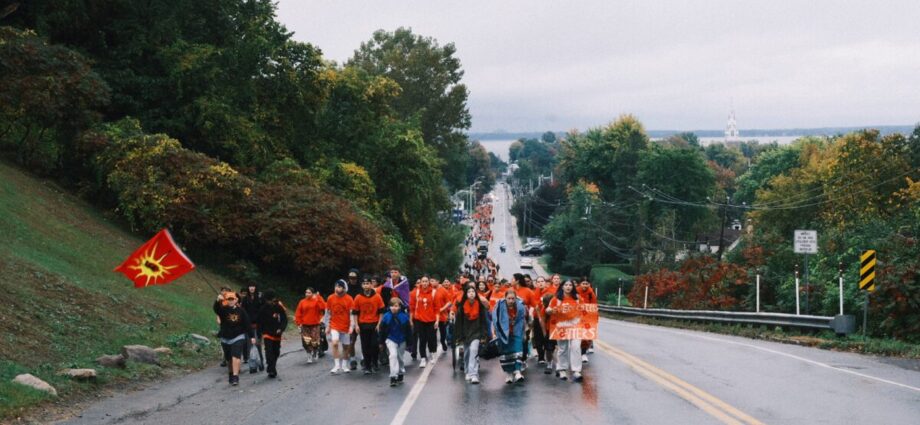
Despite the rain, more than 500 students from 10 schools walked in orange shirts on Friday, holding signs to mark the third annual Walk for Truth and Reconciliation.
The students walked from Ecole des Pins in Oka to the lacrosse box in Kanesatake on October 2, where they were welcomed with strawberry juice and a social. The event aims to bring together Indigenous and non-Indigenous students to honour those impacted by residential schools.
The students that participated were from Rotiwennakéhte Elementary School, Ratihén:te High School, Ecole des Pins, Oka Secondary School, Mountainview Elementary, Lake of Two Mountains High School, St. Jude Elementary, Gaston-Pilon Primary School, and Ecole Polyvalente Deux Montagnes.
“Kids didn’t make it out of the residential schools, and that’s why we wear our orange shirts,” said Nellie Canatonquin, an eight-year-old student at Rotiwennakéhte.
“The walk was very tiring, but I still did it because I didn’t want to give up,” she said.
Watsenniiostha Nelson, the director of education for the Kanesatake Education Center (KEC), said that the walk began three years ago with the idea of bringing nearby schools together to mark September 30, the National Day for Truth and Reconciliation.
From that idea, Nelson and other organizers formed a committee and began building the annual event. The first walk had four to five schools participate, and last year seven schools and roughly 400 students did the walk. This year, organizers had planned for 11 schools, but one school had to cancel due to scheduling conflicts.
Nelson added that at first organizers were reaching out to schools to participate, but now more schools are reaching out to join the walk.
The committee also gives presentations to the schools, providing history and context on residential schools, the walk, and the social that follows.
The growing interest has meant that the committee has had to turn down some requests for presentations because of limited time and staffing. Nelson said that the committee hopes to expand its outreach next year.

“September 30 is a very mentally heavy day for all Indigenous communities,” said Nelson, whose grandfather went to residential. “It’s not easy, however, I am very proud to be able to stand here with everybody, non-Indigenous and Indigenous, to honour all those who did attend residential schools, those who attended and never made it home, and just keep their memory going.”
Ratihén:te principal Kimberly Simon shared that her grandfather attended residential school, and the trend of people denying that history is particularly painful.
“It’s very hurtful to say it’s not real, it didn’t happen, that’s not okay,” said Simon. “That’s why I think this day and continuing to educate is so important.”
Simon added that it’s important for students not only in Kanesatake, but also the surrounding community, to learn about the dark past of residential schools and about reconciliation.
“It’s really about collaborating. It’s really about sharing. It’s about coming together with our fellow communities and growing together and moving together in a positive path forward,” said Rotiwennakéhte school principal Melissa McGregor.
McGregor added students are encouraged to ask questions and learn more about Indigenous culture.
“Many of our families have come from residential schools, and there is some residual trauma there and negative experiences,” said McGregor. “So, we’re not only healing with our fellow communities, we’re also healing within our own communities.”
Oka mayor Patrick Hardy attended the first part of the walk and said he was surprised by the number of students and schools who took part.
“It was a nice ray of sunshine with everything that’s going on in the world,” said Hardy. “I think that’s what the march represented. Just people coming together for a noble cause, recognizing that residential schools did have an impact on First Nations.”
For Adrienne Katsi’tsí:io Gareau, the Kanienʼkéha teacher at Ratihén:te, it’s important for people to remember the values behind Truth and Reconciliation are not just for one day, but for people to carry those values all year round.
“Be proud of who you are. Be unapologetically Kanien’kehá:ka. Don’t be shy to use your language. Teach others, be proud of your culture, and stand up for it too, and for all the other children, teachers – everyone who’s here with us today,” said Gareau.
fern@sharing-our-stories.com
Fern Marmont, Local Journalism Initiative Reporter

