

By Yumna Iftikhar, Local Journalism Initiative Reporter, The Independent
February 1, 2026
For many Muslims in Newfoundland and Labrador, Islamophobia became starkly real on Jan. 29, 2017, when a gunman opened fire at a mosque in Quebec City.
Ayse Sule Akinturk, an executive member of the Muslim Association of Newfoundland and Labrador (MANAL), says that for many members of the Muslim community in this province, violent cases of Islamophobia were unimaginable prior to 2017.
“We woke up to this brutal reality, that Islamophobia is real,” she says. “It exists, and it can take very violent forms — can take innocent lives. So we were really shaken to the core.”
Akinturk vividly remembers hearing the devastating news that a gunman opened fire at the Centre culturel islamique de Québec during Isha (night) prayers, killing six Canadians and wounding 19 others. She says when members of the local met right after the news, everyone was “terrified and shaking.”
Sobia Shakih, co-chair of the Anti-Racism Coalition of Newfoundland and Labrador, says the aftermath of the attack was emotionally exhausting. “I was scared. I was scared for my family across the country. I was afraid for Muslims here in St John’s. I was really fearful,” she says.
But what helped both women say was the outpouring of support the Muslim community in the province received in the aftermath of the attack. “We started seeing flowers, lots of messages of support and condolences at the door of the Masjid (Mosque),” Akinturk says.
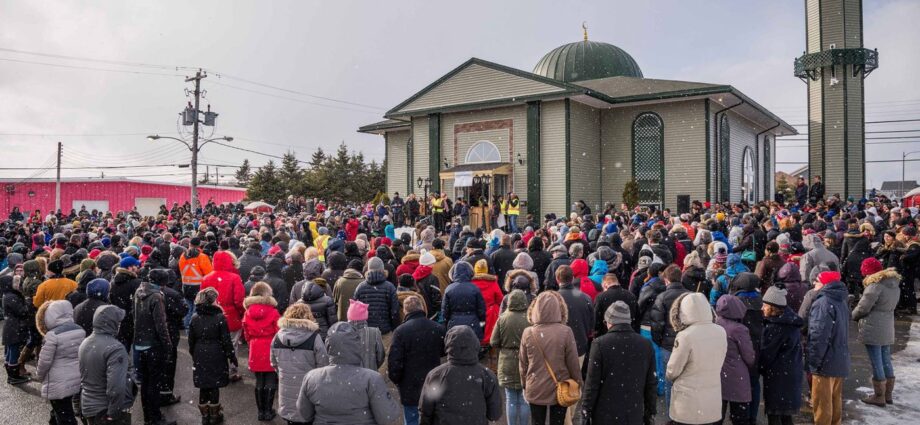
Days after, between 1,000 and 2,000 residents gathered outside the Masjid-an-Noor to form a “human shield” around the building while the Muslim community prayed inside.
“We were praying inside the Masjid, and then we noticed that there was a human shield forming around our Masjid,” Akinturk says. “People from all walks of life are coming to express their condolences and express their support and solidarity to comfort us, to give us the message that we are safe here in St John’s, Newfoundland.”
Shaikh says the support meant a lot. “That was one of the most beautiful experiences that I’d had. I didn’t know that so many people would have shown up.”

In 2019, Canada officially recognized Jan. 29 as the National Day of Remembrance of the Québec City Mosque Attack and Action Against Islamophobia.
Members of the Muslim community and supporters will be wearing a green square this week.
To commemorate the 9th anniversary of the attack, MANAL has asked municipal and provincial governments to illuminate public buildings like Government House, Confederation Building and St. John’s City Hall in green as a symbolic gesture of support and solidarity. In a video posted to the City of St. John’s social media channels Thursday morning, Mayor Danny Breen explains why he is wearing a green square today. “I wear it to remember those whose lives were taken. I wear it as a commitment to stand firmly against discrimination in all its forms.”
The Independent asked the the Government of Newfoundland and Labrador what it is doing to mark the occasion but did not receive responses by the time of publication.
In his video, Mayor Breen said Jan. 29 is “not only a day of mourning,” but also “a day of hope to come together for a future where people of all backgrounds feel safe, valued, and included.” The City of John’s will also be illuminating city hall in green this evening.
Shaikh says she will spend the day remembering the victims of the attack and thinking of other Muslims in Canada who were victims of Islamophobic attacks. She will also be reading about Islamophobia and responses from communities, organizations and leaders.
“I’m lucky because I have some place to put my anger, my worry, my fear, my pride of being part of a community that cares.”
Created a need for awareness
After the 2017 attack there was a heightened awareness that more needed to be done to counter Islamophobia and protect the Muslim community in this province, Shaikh recalls. “We didn’t feel like we had any counter to [an attack], any resistance to that. What would happen if that happened [in Newfoundland and Labrador]?”
Working on tackling Islamophobia and spreading awareness about Muslims and the community began right away, Akinturk says. “Our immediate reaction was to improve the security of our mosque so that our congregants can feel safer inside.”
The members of the mosque were “concerned and stressed” that the community could face a hate attack in Newfoundland and Labrador as well, Akinturk says. They began to monitor milder forms of Islamophobia in the province as well.
There have been multiple incidents of targeted vandalism in the province, and Muslims have faced verbal abuse. In 2022, two teenage sisters were subjected to racist comments and assaulted.
Shaikh says it is hard to count the number of cases because many aren’t reported.
Akinturk says she is glad that extreme cases of Islamophobia are not common in the province. But when attacks happen in other parts of the country, it becomes a painful reminder that Islamophobia is real and must be addressed, she says.

The mosque leaders have taken multiple precautions to enhance security and protect the building in St. John’s. Akinturk says it’s heartbreaking to think that a place of worship needs security. “Places of worship are supposed to be safe places, right? People need to focus on their prayers. They shouldn’t worry about any danger coming from outside.”
Since the 2017 attack, Akinturk says there have been multiple community gatherings and consultations with other organizations and groups that shared similar concerns about hate crimes.
In 2017, a collaboration between Memorial University researchers, including Shaikh, and the Muslim Association of Newfoundland and Labrador (MANAL) and the Anti-Racism Coalition of NL (ARC-NL), resulted in a project called Addressing Islamophobia in NL. It aimed to tackle anti-Muslim racism through community-engaged research, workshops, and educational strategies.
Subscribe to our newsletter.
MANAL also helped develop provincial and national strategies to identify and eliminate the systemic causes of Islamophobia.
