


Jonathan Paul, Royal Holloway, University of London
January 8, 2026
Greenland, the largest island on Earth, possesses some of the richest stores of natural resources anywhere in the world.
These include critical raw materials – resources such as lithium and rare earth elements (REEs) that are essential for green technologies, but whose production and sustainability are highly sensitive – plus other valuable minerals and metals, and a huge volume of hydrocarbons including oil and gas.
Three of Greenland’s REE-bearing deposits, deep under the ice, may be among the world’s largest by volume, holding great potential for the manufacture of batteries and electrical components essential to the global energy transition.
The scale of Greenland’s hydrocarbon potential and mineral wealth has stimulated extensive research by Denmark and the US into the commercial and environmental viability of new activities like mining. The US Geological Survey estimates that onshore northeast Greenland (including ice-covered areas) contains around 31 billion barrels of oil-equivalent in hydrocarbons – similar to the US’s entire volume of proven crude oil reserves.
But Greenland’s ice-free area, which is nearly double the size of the UK, forms less than a fifth of the island’s total surface area – raising the possibility that huge stores of unexplored natural resources are present beneath the ice.
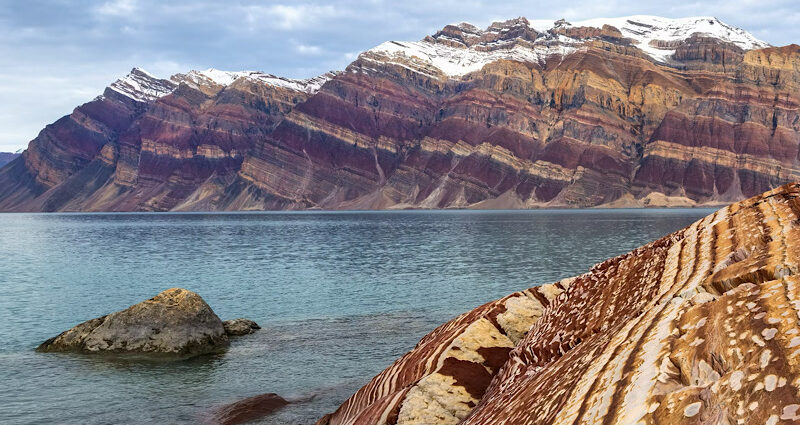
Greenland’s concentration of natural resource wealth is tied to its hugely varied geological history over the past 4 billion years. Some of the oldest rocks on Earth can be found here, as well as truck-sized lumps of native (not meteorite-derived) iron. Diamond-bearing kimberlite “pipes” were discovered in the 1970s but have yet to be exploited, largely due to the logistical challenges of mining them.
Geologically speaking, it is highly unusual (and exciting for geologists like me) for one area to have experienced all three key ways that natural resources – from oil and gas to REEs and gems – are generated. These processes relate to episodes of mountain building, rifting (crustal relaxation and extension), and volcanic activity.
Greenland was shaped by many prolonged periods of mountain building. These compressive forces broke up its crust, allowing gold, gems such as rubies, and graphite to be deposited in the faults and fractures. Graphite is crucial for the production of lithium batteries but remains “underexplored”, according to the Geological Survey of Denmark and Greenland, relative to major producers such as China and South Korea.
But the greatest proportion of Greenland’s natural resources originates from its periods of rifting – including, most recently, the formation of the Atlantic Ocean from the beginning of the Jurassic Period just over 200 million years ago.

Greenland’s onshore sedimentary basins such as the Jameson Land Basin appear to hold the greatest potential of oil and gas reserves, analogous to Norway’s hydrocarbon-rich continental shelf. However, prohibitively high costs have limited commercial exploration. There is also a growing body of research suggesting potentially extensive petroleum systems ringing the entirety of offshore Greenland.
Metals such as lead, copper, iron and zinc are also present in the onshore (mostly ice-free) sedimentary basins, and have been worked locally, on a small scale, since 1780.
Difficult-to-source rare earth elements
While not as intimately related to volcanic activity as nearby Iceland – which, uniquely, sits at the intersection of a mid-ocean ridge and a mantle plume – many of Greenland’s critical raw materials owe their existence to its volcanic history.
REEs such as niobium, tantalum and ytterbium have been discovered in igneous rock layers – similar to the discovery (and subsequent mining) of silver and zinc reserves in south-west England, which were deposited by warm hydrothermal waters circulating at the tip of large volcanic intrusions.
Critically among REEs, Greenland is also predicted to hold sufficient sub-ice reserves of dysprosium and neodymium to satisfy more than a quarter of predicted future global demand – a combined total of nearly 40 million tonnes.
These elements are increasingly seen as the most economically important yet difficult to source REEs because of their indispensable role in wind power, electric motors for clean road transport, and magnets in high-temperature settings like nuclear reactors.
The development of known deposits such as Kvanefield in southern Greenland – not to mention those not yet discovered in the island’s central rocky core – could easily affect the global REE market, owing to their relative global scarcity.

An unfortunate dilemma
The global energy transition came about due to increasing public recognition of the manifold threats of burning fossil fuels. But climate change has major implications for the availability of many of Greenland’s natural resources that are currently blanketed by kilometres of ice – and which are a key part of that energy transition.
An area the size of Albania has melted since 1995, and this trend is likely to accelerate unless global carbon emissions fall sharply in the near future.
Recent advances in survey techniques, such as the use of ground-penetrating radar, allow us to peer with increasing certainty beneath the ice. We are now able to obtain an accurate picture of bedrock topography below up to 2 km of ice cover, providing clues as to the potential mineral resources in Greenland’s subsurface.
However, progress is slow in prospecting under the ice – and sustainable extraction is likely to prove even harder.
Soon, an unfortunate dilemma may need to be addressed. Should Greenland’s increasingly available resource wealth be extracted with gusto, in order to sustain and enhance the energy transition? But doing so will add to the effects of climate change on Greenland and beyond, including despoiling much of its pristine landscape and contributing to rising sea levels that could swamp its coastal settlements.
Currently, all mining and resource extraction activities are heavily regulated by the government of Greenland through comprehensive legal frameworks dating from the 1970s. However, pressures to loosen these controls, and to grant new licences for exploration and exploitation, may increase amid the US’s strong interest in Greenland’s future.
Jonathan Paul, Associate Professor in Earth Science, Royal Holloway, University of London
Subscribe to our newsletter.
This article is republished from The Conversation under a Creative Commons license. Read the original article.
