

By Sonal Gupta, Local Journalism Initiative Reporter, Canada’s National Observer
June 25, 2026
New camera footage from Canada’s first LNG export terminal is raising concerns about invisible pollution and whether current monitoring adequately detects what reaches nearby communities.
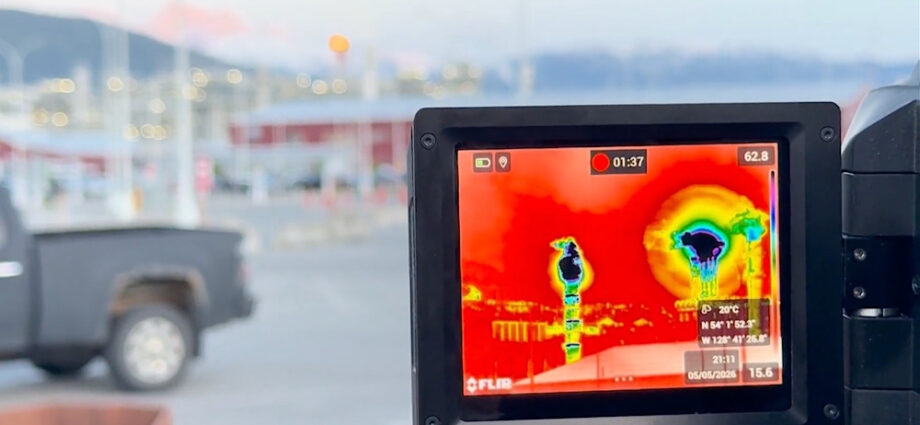
To the naked eye, the sky looks mostly clear above LNG Canada’s Kitimat facility on the northern coast of BC. But footage taken with a specialized infrared camera and presented at a media briefing Wednesday showed dark plumes around flares, stacks and processing equipment.
Tim Doty, a former Texas environmental regulator and air monitoring specialist, said he filmed outside the facility over several days in May using a camera that makes some gases and emissions visible on video. Similar plumes appeared in footage taken from several locations around the facility.
“These are continuous emissions that are not visible to the bare eye and this is what is being blown downwind to the Kitimat area,” Doty said. Kitimat is home to 8,236 people, according to the 2021 census.
The footage raises health concerns because some pollutants linked to flaring and LNG processing can affect the lungs, heart and other organs, said Tim Takaro, a physician-scientist and Simon Fraser University professor emeritus in the health sciences faculty, at the briefing. He added people in the community have reported irritated lungs, noses, throats and eyes, along with increased use of inhalers.
“What that means in the community is not well understood,” he said. “We really need to get a better handle on what these health effects are.”
Doty said the emissions could include methane, benzene, other volatile organic compounds, formaldehyde, nitrogen oxides and carbon monoxide, but the camera cannot identify the exact chemicals or measure how much is in the air. He determines what the camera is showing through a process of elimination: what the camera can detect, what the company has reported about the gas being processed and what pollutants are normally created when that gas is burned.
“Your regulator has to go in and investigate and inspect the plant and hold the company accountable,” Doty said.


The new footage builds on earlier concerns about flaring at the LNG Canada plant, where excess gas is burned off through tall stacks. Observers have suggested excess flaring could not only cause air pollution but also waste gas that could otherwise be fuel.
A March emissions report showed cracks had developed in one of the facility’s flare systems in February. Gas that would normally go through that system was being diverted to a spare flare — used when the main system is unavailable — and was the largest source of flaring by volume that month, the report said.
A newly obtained April report shows the flare problem continued the next month. LNG Canada told the regulator the damaged flare tip was still waiting to be replaced, with work planned to start June 15. The same report says three flares burned off more gas than allowed, including the spare flare, which averaged more than 18 times its routine limit.
Thomas Green, senior climate policy adviser at the David Suzuki Foundation, said he is concerned BC could follow a pattern that has played out in Alberta, where regulators responded to excessive flaring by increasing the allowed limit. The amount of gas discussed now in BC would be enough to heat 37,000 homes for a day, he added.
“That is a lot of gas being flared. It’s a lot of wasted product, and it means a lot of combustion byproducts that are going to be in that airshed and can affect people downwind,” he said.
In an email response, a spokesperson for LNG Canada toldCanada’s National Observer it uses real-time monitoring on combustion equipment at the facility, including for nitrogen oxides and other indicators of how efficiently equipment is operating. The company said the data is reported to regulators and checked through regular stack testing.
Takaro told Canada’s National Observer that Northern Health, the regional health authority for the BC region, had asked during the air permitting process that LNG Canada be required to have a stationary camera on the flare.
The camera was approved and included in the permit, but Northern Health has not been able to access the footage because it is controlled by the BC Energy Regulator and destroyed after 30 days, Takaro said.
“After a year of frustration, we placed our own camera so that we could control the images,” he said. “And those are definitely recording pollution heading into the community.”

Ankur Patel, a Kitimat-based registered nurse and representative of the Canadian Association of Nurses for the Environment, said the footage was not surprising to some residents but made invisible pollution easier to understand.
“We know that these emissions exist and are ongoing,” Patel said in an interview with Canada’s National Observer.
Patel has pushed Kitimat council to support a broader health assessment of the LNG industry to look at possible health impacts from gas extraction, pipelines, processing, export facilities and the eventual burning of the fuel.

“What happens is you get a piecemeal of various clusters of stuff that happen separately, but you do not have a full comprehensive picture of the chain,” Patel said. Letters provided to Canada’s National Observer show Hazelton and Dawson Creek support the request for an independent health assessment of BC’s gas industry. Patel said Terrace, Squamish and New Westminster have also passed motions in support.
But Kitimat council has not supported the request. Patel said some councillors questioned whether it was fair to focus on LNG in an industrial town, while others were satisfied with existing provincial oversight.
Advocates said BC’s Environmental Assessment Act allows the province to conduct broader regional or strategic assessments that could examine the cumulative effects of the gas and LNG industry, but no such review has been completed.
“The picture has shifted from what we were promised by the province and a comprehensive health assessment should follow in kind,” Patel said.
In an email response, a spokesperson for the BC Energy Regulator said it issued an order in April requiring LNG Canada to address black smoke emissions and said further enforcement action can be taken if non-compliance continues.

DHgate
Shop millions of products from China at attractive prices — while supporting The-14 through our affiliate link. Women’s Apparel, Electronics, Shoes, Accessories, B2B, and more.
Visit StoreThe spokesperson added air monitoring in Kitimat has not recorded pollution above provincial air quality objectives since the permit was issued in 2024. They acknowledged LNG Canada has reported repeated flaring that did not meet permit requirements and the regulator has required LNG Canada to hire an independent expert to update its air quality assessment. They added the assessment has detected a “small to negligible” impact on local air quality.
The spokesperson also said the regulator has required LNG Canada to reduce flaring, repair its flare system and carry out additional air quality monitoring.
The LNG Canada spokesperson said the facility is still in its early operating phase, when higher flaring is expected while systems are stabilized. The company said it is asking BC regulators for a temporary change to its air-emissions permit, supported by updated pollution modelling and a human health risk assessment.
“Optical gas imaging can be a useful screening tool for identifying the presence and general movement of certain hydrocarbon plumes, but imagery alone cannot determine whether a plume contains benzene, how much of any substance is present or whether it results in harmful exposure in the community,” the spokesperson said.
Those questions require measured data such as stack sampling, continuous emissions monitoring, modelling and ambient air monitoring, the spokesperson added.

New Balance Canada
Shop premium athletic footwear and apparel from New Balance Canada — while supporting The-14 through our affiliate link.
Visit StoreThe company said three air monitoring sites in Kitimat show air quality remains well within BC health-based limits. The spokesperson added that one site also measures total hydrocarbons, a broader category that includes volatile organic compounds such as benzene and said those readings are very low.
Canada’s National Observer reached out to Kitimat council but did not hear back before publication deadline.
Subscribe to our newsletter.
Sonal Gupta / Local Journalism Initiative / Canada’s National Observer.
