

Timothy Martin, Simon Fraser University
October 15, 2026
We have been bombarded in recent weeks with apocalyptic headlines about “artificial super-intelligence” and the possibilities of a new era of “artificial general intelligence” (AGI) in which AI achieves human capacities for reason and learning.
Concerns vary from its misuse in bioterrorism to the capacity of AI agents to form collectives, “go rogue” and perform unauthorized attacks on systems, or even to take over the internet and terminate humanity.

As a scholar interested in public memory, I find myself returning to the writing of Wendell Berry in response as a source of wisdom for these turbulent times. Berry, who died at home in August, was a cultural critic, writer, farmer, environmentalist and an early influence on my thinking. His book, Life is a miracle: An essay against modern superstition reads as an eerie letter to the purveyors of AI.
For Berry, the mind was shaped by its place in the world, the textures of the local, a sense of home and a notion of history. To have a mind, argued Berry, one must have a world. In a section of the book titled, “Creatures as machines,” he railed against the way in which the metaphor of mind as machine, has turned into an equivalence.
The death of the earth
Some thinkers believe AI promises to save us from work. Elon Musk has made radical claims that AI will make work optional within the next two decades. But part of taking our place in the world — and in time — is through work.
Berry himself gave up a promising life in New York’s literary scene to move back to Kentucky and work the land. Of course, he continued to produce written works as well: no less than 50 books.
Some analysts also claim that AI could reduce inequality. Berry addressed similar promises made by 20th century science in the domains of nuclear power, genetic engineering and industrial agriculture.
In the face of systems that were meant bring us global food security, Berry declared that many of us are now mourning “the progressive death of the Earth.”


Technology without consent
We are already witnessing how AI is accelerating many breakthroughs in the sciences — from solving previously unsolvable mathematics problems to diverse transformations in health care and disciplines as diverse as meteorology and synthetic biology. Many commentators within science and the AI industry have drawn parallels between AI and the Industrial Revolution.
The better comparison may be with nuclear weapons. Geneticist Wes Jackson, founder of the Land Institute, once warned “we ought to stay out of the nuclei.” Jackson was concerned about corporate patents on genetically engineered seed crops and the destructive potential of nuclear fission.
As a plant geneticist, Jackson himself developed innovative perennial grains by looking to the natural resilience of prairie plant communities. By “entering” the nuclei, Jackson held that we were crossing a threshold that should remain off limits to humans, given the risks involved.
Quoting his friend and collaborator Jackson, Berry invoked a notion of planetary and creaturely consent: “When a few scientists decided to go in, they decided for everybody.”
Similarly, when Musk warns of a 20 per cent chance of AI destroying humanity and still plugs away at developing it, he is deciding for all of us.
Avoidance of difficult thoughts
It’s tough to argue against the expedience brought about by computers, smart phones and artificial intelligence. And yet Berry showed us how the totalitarian regimes of the 20th century grew in alignment with the development of mechanical processes.
If freedom is our express purpose, Berry argued, then democracy actually requires instruments that impede operation. These include trial by jury, consent of the governed and the idea of minority rights — all concepts with processes that are frustratingly inefficient but more equal and free.
AI apologists are fond of dismissing doubters and critics as Luddites. But the Luddites themselves protested precarious work and food insecurity in an age of widespread economic inequality in 19th century England. Berry, in a couple of instances, identified with the Luddites.
The common refrain when it comes to technological development is to embrace it as inevitable. Berry described this recourse to inevitability as the avoidance of difficult thought.
Minds like trees or computers?
For the German philosopher Martin Heidegger, technology was less about the knobs and buttons and more a particular expression of reality, influenced by our immersion in particular tools and activities.

And there is the impasse. For some, inevitable AI is part of “the way reality discloses itself.” To others, an entirely different existence is made possible by attending to the body, land and material objects. The difficulty today is the distance between these two realities.
Avoiding the digital screen, Berry wrote in “How to Be a Poet (to remind myself),” was a simple matter of staying “away from anything that obscures the place it is in.” In the same poem, he wrote that that “a tree forms itself in answer to its place and the light.”

It’s perhaps difficult to conceive of ourselves as creatures, tethered to other creatures and to places — the way trees are wedged into soil and connected by underground mycorrhizal networks. It’s maybe easier to accept we are merely computers, and that by making better computers we take the pressure off the computer that lives somewhere between our ears.
In Berry’s words: “It is easy for me to imagine that the next great division of the world will be between people who wish to live as creatures and people who wish to live as machines.”

How to live in community
If he was still with us, Berry might remind us to judge what we make not for its independent utility, but for its wider relationship to the community. Berry despised the word “environment,” and the notion that “we” might be separate from “it.” Instead, he demanded that we conceive of ourselves as part of a community — including creatures, places, the dead and those not yet born.
He would invite each of us, tech innovators included, to speak a common language and openly reveal our inventions. He disliked academic over-specialization and feared loss of accountability and understanding across disciplinary boundaries.
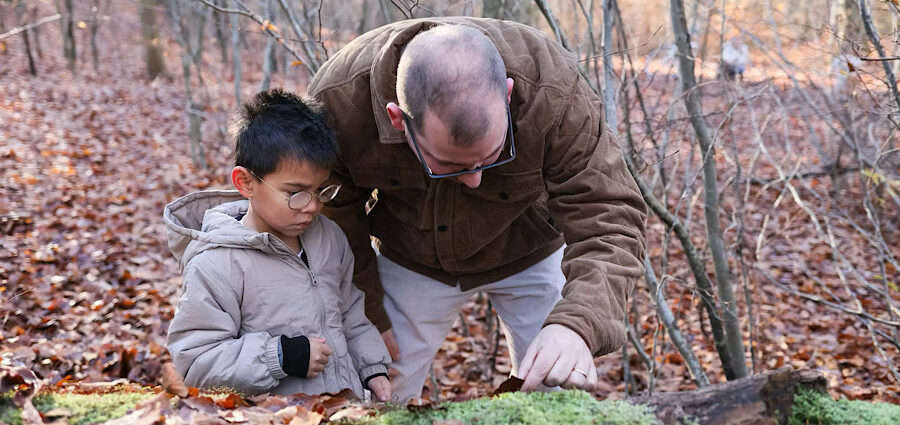
He would tell us to find a place, get to know it and consult the land — an essential educational opportunity in an age of declining ecological knowledge and numb senses.
If I listen hard, I can hear Berry’s voice: Go slowly; be quiet; plant seeds; restore local watersheds; eat what grows; build community with all creatures that come.
Timothy Martin, Postdoctoral fellow, Faculty of Education, Simon Fraser University
Subscribe to our newsletter.
This article is republished from The Conversation under a Creative Commons license. Read the original article.

.jpg)