

By George Lee, Local Journalism Initiative Reporter, The Macleod Gazette
February 16, 2026
Alberta and the federal government remain on course to reach a carbon pricing agreement pledged within their Nov. 27 memorandum of understanding, the province’s new environment minister said last week.
Calling the system “a very complex way of dealing with industrial carbon pricing,” Grant Hunter said Alberta’s large emitters are competitive at the current rate of $95 per tonne of emissions of carbon dioxide equivalent.
“There are a lot of nuances to this, but we’ve got until April 1 to be able to get the next stage done in the MOU and I think we’ll make it,” said Hunter, the MLA for Taber-Warner.
That doesn’t necessarily foreshadow an increase in pricing April 1. Rather, it means Alberta and Ottawa will have reached an agreement committing the province to — as the MOU puts it — “ramp up” pricing to $130 per tonne.
The MOU doesn’t prescribe exactly when Alberta will hit the target. But it does say both Canada and Alberta “remain committed to achieving net zero greenhouse gas emissions by 2050.”
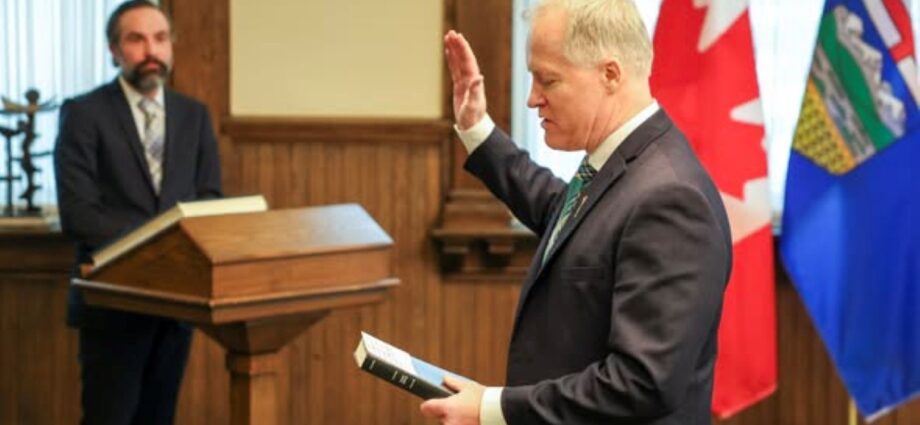
Hunter’s comments followed a related announcement in his first major press conference since being appointed minister of environment and protected areas in January.
Drawing from a pot of money created through carbon pricing, he announced $28 million in funding for six projects that strive to increase production while reducing the release of greenhouse gases.
The Economic Component
The MOU reached by Premier Danielle Smith and Prime Minister Mark Carney ties Alberta carbon pricing to progress on getting a pipeline built.
Before the MOU was signed, Alberta had frozen its rate at the 2025 level of $95 per tonne, putting the prairie province at odds with a federal schedule requiring the rate to increase to $110 per tonne on April 1.

“If we are to go up to 130, which is what some have said that the price needs to be, then I think we’re going to have to work through that with industry and make sure (industry) can still be competitive,” said Hunter.
Critics of the MOU said it sacrificed the environment at the altar of Canadian economic development, after Carney was elected on a mandate of dealing with Donald Trump and his tariffs.
Much of the verbiage in the MOU does centre on the economy. The document calls itself an “agreement to strengthen energy collaboration and build a stronger, more competitive and more sustainable economy.”
But Hunter thinks resource development, innovation and environmental progress can and do work in tandem. “We’ve proven in Alberta for decades that you can be champions of the environment and still be the economic engine of Canada,” he said.
‘Innovate Rather Than Legislate’
From 2019 to 2021, Hunter was associate minister of red-tape reduction, earning him kudos in business circles. He’s credited with orchestrating a turnaround in Alberta’s grade for red-tape reduction awarded annually by the Canadian Federation of Independent Business.
Alberta climbed to a country-leading A in the eyes of the CFIB in 2021 from a bottom dwelling F behind all other provinces and the federal government.
Most recently, Hunter was associate minister of water under Environment and Protected Areas.
Hunter doesn’t consider a red-tape-cutting mindset in conflict with environmental protection.
“I have always been a believer that we will innovate rather than legislate our way out of the problems. Not just Albertans, but people throughout the world, have proven that we’re better innovators than legislators.”
Transformative Tech
In Coaldale within his southeastern Alberta riding Feb. 12, Hunter announced $28 million from Emissions Reduction Alberta for six projects with a total value of more than $172 million.
The funding through ERA’s Industrial Transformation Challenge will help create more than 1,000 jobs and add almost $167 million to the Alberta economy by 2027, the province estimates. And the projects could cut 260,000 tonnes of emissions by 2030.
Established in 2009, the agency allocates monies that large emitters of greenhouse gases pay the provincial government at a current rate of $95 per tonne. So far the agency has committed almost $1 billion towards 316 projects valued at over $10 billion.
This time, investments range from $625,000 to $12 million, including a first-of-its-kind facility in Coaldale that converts agricultural byproducts into renewable natural gas and soil additives.
Also on the list is a technology to reduce pipeline fractures. Based in Suffield near Medicine Hat, the system is touted as a future supporter of carbon capture, utilization and storage, or CCUS.
Among the four other projects is a University of Calgary initiative in Leduc County near Edmonton to advance electrokinetic remediation for inactive oil and gas sites. The work aims to expand the system’s ability to remove salts and hydrocarbons simultaneously.

Another supported project, based in Yellowhead County about 250 km west of Edmonton, is testing carbon capture technologies on compressor engines. Its goal is to develop units that evaluate scalability and future sequestration of carbon.
Subscribe to our newsletter.
Hunter said projects of the kind receiving ERA money are typical of a province that consistently “punches above its weight” economically and environmentally.
