

By William Koblensky Varela, Local Journalism Initiative Reporter, Nunavut News
November 13, 2026
The Qikiqtani Inuit Association and the Government of Nunavut want a full public review of the proposed Iqaluit Nukkiksautiit Hydro Project, even though the Nunavut Impact Review Board (NIRB) says it wasn’t necessary.
On Nov. 4, NIRB said the territory’s first hydro project could proceed without community consultation because hydroelectric dams are a well-known technology with predictable impacts.
But the QIA, GN and federal government agencies raised environmental concerns about the planned power plant.
“QIA is preparing to undertake its own community engagement in Iqaluit and Pangnirtung,” the organization stated on Nov. 10.
The project was proposed by the QIA’s subsidiary, Nunavut Nukkiksautiit Corporation.
Fish habitat, wildlife, permafrost and terrain, Inuit harvesting, travel and access are among the issues that the QIA wants to speak with community members about.
Reservoir filling of the hydroelectric dam and its operation, on top of downstream flows and water quality, are also of concern to the organization.
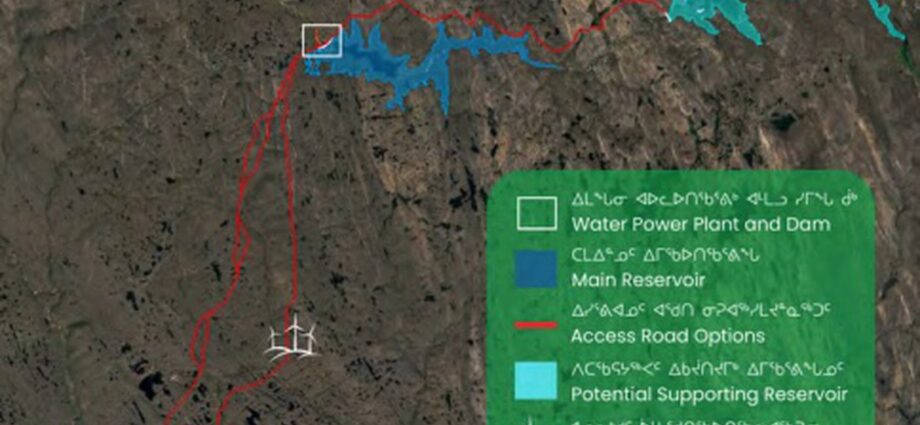
The dam would include a hydroelectric facility of up to 30 megawatts on the Kuugaaluk River, a reservoir of approximately 17,633 acres, and an access road and transmission line running 66 km.
How the dam’s noise might affect caribou migration is an issue the GN raised, along with potential impacts on the Arctic char population.
The federal government did not explicitly say it is seeking a public review, but federal agencies identified potential environmental impacts.
Fisheries and Oceans Canada said there wasn’t enough information about how the Arctic char population would fare after damming the Kuugaaluk River.
Health Canada stated that the dam could poison country food.

Environment and Climate Change Canada said water quality and bird species could be put at risk.
The dam could harm the stability of permafrost, according to Natural Resources Canada.
The Iqaluit Nukkiksautiit Hydro Project could replace 130,000 tonnes of greenhouse gas emissions with renewable electricity, significantly reducing environmental effects on wildlife and humans.
Nunavut Nukkiksautiit Corporation promised to address all environmental concerns by speaking with the Amaruq Hunters and Trappers Association in Iqaluit and the Pangnirtung Hunters and Trappers Organization, in addition to conducting studies and designing the dam to mitigate environmental impacts. NIRB said that was enough for the project to proceed without a public review.
“While the NIRB recognizes that considerable development and refinement of the project proposal is required if the project proposal advances through Nunavut’s integrated regulatory system, the NIRB also recognizes that for most components of the project, this level of detail is not required for the NIRB to complete its screening and determination of whether a review is triggered,” the regulatory board stated.
In November 2025, the Iqaluit Nukkiksautiit Hydro Project was fast-tracked by the federal government’s Major Projects Office.
Projected to save $1.9 billion in diesel costs over the next 50 years, the full cost of the project and a timeline for construction have not been publicly released.
Nunavut Nukkiksautiit Corporation received $6 million for dam engineering and design work from the Canadian Northern Economic Development Agency in January.
In 2021, the project received $7 million for feasibility studies from Crown-Indigenous Relations and Northern Affairs Canada.
Subscribe to our newsletter.
The initiative was originally suggested by Qulliq Energy Corporation (QEC) in 2005, and the utility spent $10 million studying two separate areas for a dam before deciding it cost too much.
A 2017 QEC research document put the cost of the dam at more than $300 million.
