

Saul Ngarava, University of Lincoln; Daniel Magnone, University of Lincoln, and Eric Ruto, University of Lincoln
September 7, 2026
Saltwater isn’t something most people associate with English farmland. But in parts of eastern England, it’s becoming a growing problem, and not just for crops, but for farm incomes too.
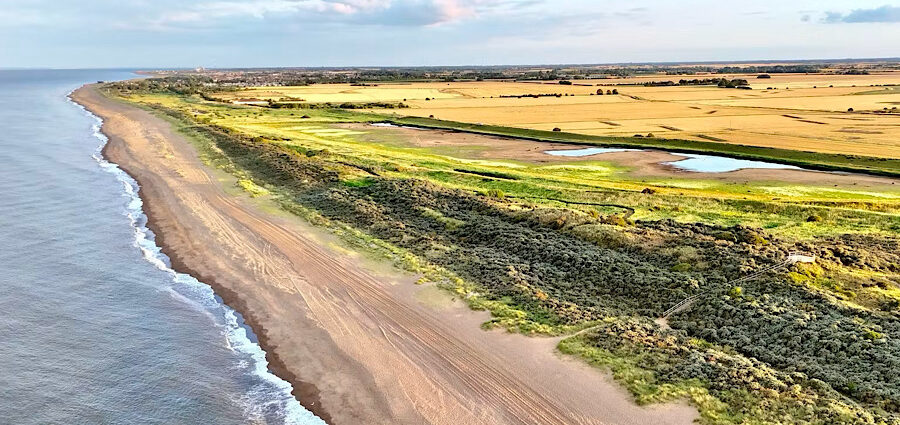
In our new study focusing on Greater Lincolnshire, one of the UK’s most productive agricultural areas, we found that rising sea levels and more frequent flooding are pushing salt onto some of the country’s best farmland.
This isn’t just about crops struggling to grow. The real story is an economic one. Salt in the soil is changing which crops actually make money, and in some cases wiping out profits entirely.
Most studies on salinity look at what happens in the field. For example, how plants respond to increasing salt concentrations, how yields fall and how soils degrade.
We have been researching the problem from a farmer’s perspective. What happens to their income? How does risk change? And crucially, what can farmers grow instead when conditions shift?
To answer these questions, we combined maps of crops, land quality and flood risk with farm-level financial data and simulated what happens when salinity increases. The results were clear. Every major crop loses money as salt levels rise.
Some crops are hit much harder than others. Potatoes take the biggest losses, largely because they are expensive to grow, so when yields fall, profits collapse quickly. Crops like beet and oilseed also see large declines. Even cereals, which are generally more resilient, are not spared.
But the most important shift isn’t just that profits fall. It’s that the whole system changes. Under normal conditions, farming works with a kind of pecking order whereby some crops deliver high returns, others are safer but less profitable.
Salinity flattens that hierarchy. Instead of clear winners and losers, most crops end up clustered together in a lower-return, higher-risk situation.
One crop consistently stands out: winter wheat. It still suffers losses, but it holds up better than the others, making it the most reliable option as conditions deteriorate. In practical terms, that means farmers may increasingly fall back on it as their safest choice.

This matters because the places most exposed to saltwater flooding, especially the low-lying Fenlands, are also some of the most productive farmland in the UK. So this isn’t about marginal land becoming less useful. It’s about some of the country’s agricultural heartland coming under pressure.
There’s another complication. Salinity doesn’t just disappear when the floodwater drains away. Salt builds up in the soil and can linger for years, quietly reducing productivity over time. That makes it a slow-moving problem, but one with long-lasting consequences.
Over time, this could narrow farmers’ choices. Instead of a diverse mix of crops, more land could shift toward a smaller number that can cope with salty conditions. That has implications not just for farm incomes, but for food production and resilience more broadly.
Salty shifts
So what can be done? In the short term, adaptation is likely to mean shifting toward more resilient crops. Barley is already relatively salt-tolerant. Some wheat varieties cope better than others, and farmers are starting to move in that direction where risk is lower.

There is longer-term potential in crops that actually thrive in salty conditions, known as halophytes, edible saltmarsh plants like samphire. These are grown in the UK, but mostly as niche, high-value foods rather than mainstream crops. Scaling them up would require investment, new markets and changes in farming systems.
Our findings show that salinity isn’t just another environmental challenge. It’s a slow, structural pressure that changes how farming works. It affects not only yields, but decisions such as what farmers plant, how they manage risk and how land is used.
We’re not yet at the point where UK farming can switch to salt-proof crops. But the pressure from salinity is growing, and could push both crop choices and agricultural innovation in that direction over time.
Saul Ngarava, Postdoctoral Research Associate, Natural Sciences, University of Lincoln; Daniel Magnone, Associate Professor in Physical Geography, University of Lincoln, and Eric Ruto, Senior Lecturer in Economics, University of Lincoln, UK, University of Lincoln
Subscribe to our newsletter.
This article is republished from The Conversation under a Creative Commons license. Read the original article.

