

By Jayden Davis, Local Journalism Initiative Reporter, Aylmer Express
July 22, 2026
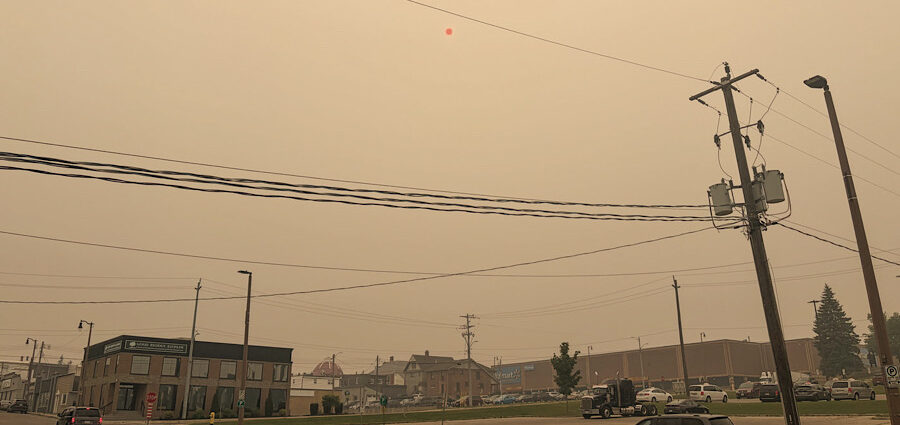
Last week multiple wildfires in northern Ontario covered the province in smoke. Environment Canada issued an Orange Air Quality warning for a majority of Ontario. The wildfires have been caused by lightning and recent unusually hot and dry conditions.
Smoke from the wildfires carried across the country, bringing some of the worst air quality in the world to Ontario. Toronto had the worst air quality in the world from Wednesday until Saturday.
On Wednesday, smoke could be seen and smelled starting in the afternoon, carrying into Saturday morning. With the air quality health index (AQHI) at a 10+, or “extremely hazardous”, people were recommended to stay inside.
If outside, an N95 or NIOSH-certified respirator mask was recommended. When driving, using the air-recirculation button would stop any outside air from being blown in the car by the air conditioning. Clean Air Solutions, an HVAC company from St. Thomas and London, recommended people to use furnace filters and a circulation fan to keep air-borne particles to a minimum.
People at higher risk due to general health or breathing difficulties should be checked on frequently.
Dr. Ninh Tran from the Southwestern Public Health Unit, said “Some people have a higher health risk from exposure to wildfire smoke, such as infants and young children, the elderly, people who work outside, pregnant individuals, and those who have chronic health conditions.”
Most of the wildfires are in the Wabakimi Provincial Park area, near Thunder Bay. On Monday another evacuation order was issued, just two hours north of Thunder Bay in the Gull Bay and Armstrong area.
The poor air quality is measured in fine particulate matter, or PM2.5. Port Stanley and St. Thomas both peaked between 300-400 μg/m3. Hazardous levels are considered 250μg/m3 or more.
According to Environment and Climate Change Canada, the wildfire was the most widespread across the province in recent history, including more than mid-June of 2023. Three years ago, 2023 marked the worst wildfire season in Canada’s recorded history, resulting in more than 180-thousand square kilometres of forest burned. Last year was the second worst, with 2025 having around 90-thousand square kilometres of forest burned. This year has had a slower pace of wildfires than both years.

The wildfires from 2023 result in a record 5,584 hours with AQHI ratings above 10. So far this year, wildfires have resulted in approximately 1,000 hours with AQHI ratings above 10. According to the Canadian Wildland Fire Information System, around 26-thousand square kilometres have burned since June.
Wednesday and Thursday had the worst air quality in the area, with multiple events being shut down in the area. The Aylmer pool, youth soccer games and summer markets were all cancelled or postponed, while Aylmer, Malahide and Central Elgin issued a fire ban.
As of Thursday afternoon, St. Thomas-Elgin General Hospital saw no increase in respiratory illnesses in the Emergency department.
Subscribe to our newsletter.
On Monday afternoon, the smoke has cleared in southern Ontario, and Port Stanley and St. Thomas have returned to their regular air quality. The wildfires still rage in the north, with six new fires reported near Thunder Bay on Monday.
