

By Noah Korver, Local Journalism Initiative Reporter, Yukon News
May 31, 2026
A new study by researchers at Carleton University, McMaster University, and the University of Saskatchewan says thawing permafrost is accelerating acid rock drainage pollution across hundreds of Yukon watersheds.
The report identifies a previously undocumented phenomenon in the Yukon that is rapidly acidifying formerly healthy watersheds and producing contamination similar to mining runoff, despite no point source.
The researchers’ findings attribute this sudden degradation to acid rock drainage caused by thawing permafrost exposing sulphur-rich rock formations to the environment.
According to the report, the thawing permafrost is causing previously sealed rock formations to become exposed to the environment. When these rocks interact with liquid water and oxygen, sulphur-based minerals called sulfides react to form a highly corrosive solution of sulphuric acid and dissolved heavy metals.
This process is known as acid rock drainage (ARD). The loss of the permafrost layer also leaves behind a more porous environment, allowing the ARD solution to leach more easily into nearby waterways.
Thaw induced ARD has previously been observed in Alaska’s Brooks Range mountains, as well as in the South American Andes, the Pyrenees mountains in France and Spain, and the European Alps where it has resulted in the devastation of aquatic life and the so-called “rusting” of streams.
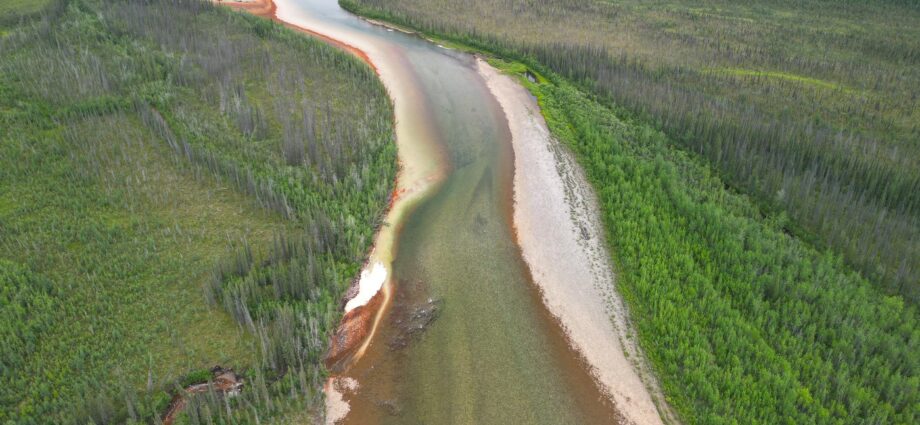
This rusting is a primary characteristic of ARD pollution. The rust actually consists of slimy red, orange, yellow and white sludge that is formed when heavy metals and sulphuric acid in ARD react with each other in water and become solid-state mineral byproducts. This sludge can coat waterways and choke out native plant life and carry heavy metals far downstream, leaching toxicity far from the initial source of the pollution. The signature bright red, orange or yellow colour of this sludge has often led people to describe this form of pollution as a rusting or rusted river.

This phenomenon was specifically highlighted in the report when, in July 2025, researchers collecting water samples near the Ogilvie River observed a plume of this sludgy material emanating from a creek known to be polluted by ARD. This plume was visible up to three kilometres downstream of where the creek entered the river and was found to be “surpassing acute toxicity thresholds for most terrestrial and aquatic organisms by several orders of magnitude.”
In addition to the immediate effects of this brightly coloured sludge, heavy metals present in ARD can also have serious toxic effects when ingested by humans. Many are also known carcinogens, and some have also been linked to brain and kidney damage, anemia, and nerve damage. Chronic exposure to some metals, such as cadmium, before and during pregnancy has been linked to higher rates of birth defects and neurological disorders.
While the toxicity of these pollutants is well known, current research on downstream pollution is minimal given the relative immaturity of this research. Skierszkan says his team aims to expand their work to include ongoing monitoring of downstream waterbodies in order to understand how these polluted tributaries might affect their larger catchments
Researchers say the potential scale of pollution linked to thaw-induced acid rock drainage is significant. With sulphide minerals occurring naturally in most rock types and permafrost underlying much of Yukon, Skierszkan explains that thousands of watersheds could face some risk of contamination as thawing continues, though he notes that this still represents a relatively small share of the territory overall.
“Most watersheds are not going to be affected, the areas that are higher risk are driven by geology”, says Skierszkan explaining how areas lacking the right type of sulfide bearing rock are not at risk. “The areas that are at higher risk are in the central and eastern portions of the territory, where there are big packages of rocks that have higher concentrations of these sulfides”.
Skierszkan says researchers plan to continue studying how permafrost degradation contributes to acid rock drainage and to better identify areas at risk of contamination. He says expanded monitoring and updated data are needed, noting much of Yukon’s geological and water-quality information is based on samples collected in the early 2000s.
“The government collected about 30,000 stream water samples about 20 years ago,” Skierszkan said, describing how his team combed through this massive data set and identified areas that produced higher concentrations of polluted samples.
In the north and eastern areas of the territory, about one in 50 samples was acidic. “Whereas in other parts of the territory, basically the west, that ratio is much lower,” Skierszkan said. “So we know there’s a higher risk in that area, and we need to improve our geological maps and collect more samples over time to see if that number is going to change over the coming years”.
The team has also incorporated satellite imagery to help identify areas of interest that can then be examined in the field. The work of identifying areas of interest has also afforded the team an opportunity to collaborate with local First Nations, and researchers have worked in close partnership with members of the Trʼondëk Hwëchʼin First Nation since the project’s outset in 2019. Skierszkan says the collaboration has been crucial in advancing the work this far and that “it would be meaningless to do this work without local connections”.
In the years ahead, the team hopes to secure continued funding to monitor long-term changes in these watersheds to expand their work to include more investigation of downstream effects in larger bodies of water such as the Yukon, Ogilvie, and Peel Rivers.
Subscribe to our newsletter.
Contact Noah Korver at noah.korver@yukon-news.com

