

By George Lee, Local Journalism Initiative Reporter, The Macleod Gazette
February 25, 2026
No detailed plan existed last week to help voters parse nine questions that challenge what it means to be an Albertan within Confederation.
But it does look like government-organized town halls or debates lie ahead, as citizens start hashing through the content and implications of an unprecedented fall referendum on immigration and constitutional issues.
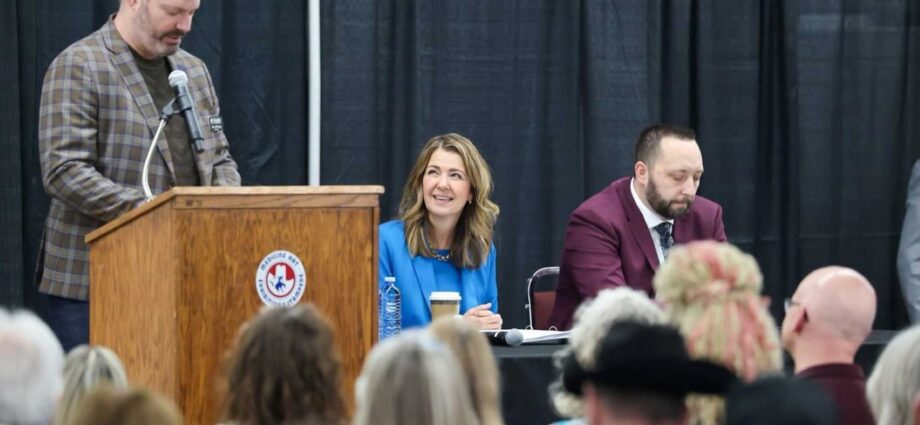
“I think we’re already seeing a lot of informal debate in the media, online and probably around kitchen tables,” Premier Danielle Smith said in an emailed response to Macleod Gazette questions.
“Although no formal debates or town halls are planned at this time, we’ll keep Albertans updated when those opportunities are available,” she said.
Federal Reach Targeted
Citizens learned in a televised and streamed address last Thursday that they’ll be asked to vote on taking greater control of immigration.
In the question mix are whether Alberta should set fees or place restrictions on services for some types of non-permanent residents. One question asks whether proof of citizenship should be necessary for voting in provincial elections.
The Oct. 19 referendum will look at prioritizing provincial laws over federal laws when they conflict; retaining Ottawa dollars when a province rejects federal programs in overlapping jurisdictions; abolishing the Senate; and having provinces appoint judges to their high courts.
In her address Smith linked an anticipated multi-billion-dollar budget deficit to federal immigration policies under Justin Trudeau, rapid Alberta population growth and declining oil and gas revenues.
The questions stem from recommendations of the Alberta Next Panel, which made 10 stops across the province last fall and summer with Premier Smith as chair. They reflect “far and away the issues most strongly identified by Albertans” through in-person and online positions, she said.

Opposition Responds
NDP Deputy Leader Rakhi Pancholi responded: “I strongly dispute the idea that the Alberta Next Panel, in that process, was in any way a clear consultation and engagement with Albertans.”
Speaking to reporters at a Friday news conference, Pancholi said that panel questions were “fashioned in such a way as to get to a predetermined outcome.”
Continued Pancholi: “If the premier is convinced that this is what Albertans really want, she should call an election and let us decide in the purest form of direct democracy possible, an election. Let’s do that.”
In her email to the Gazette, the premier said: “Look, I know a lot of folks are shocked we aren’t calling an election, given how well we are doing in the most trusted polls.
“But I have a year and a half left to keep making our province a better place to work and live, and these referendum questions will be a big part of that.”
Alberta subsidizes all of Canada through equalization payments and transfers, said the premier in her address. It can’t afford to give free access “to anyone who moves here” to social programs she called “the most generous in the country.”
The province can’t continue to “permit the federal government to flood our borders with new arrivals,” Smith said.
“This is not only grossly unfair to Alberta taxpayers, but also financially crippling and undercuts the quality of our health care, education and other social services.”
Over the final five years of Trudeau’s tenure as prime minister, Alberta grew by almost 600,000 people to more than five million while Ottawa “throttled our most important job-creating industries and prioritized immigration away from economic migrants,” said Smith.
The immigration emphasis — dialed back under Mark Carney — had shifted to international students, asylum seekers and temporary workers, which placed heavy demand on government services and facilities that couldn’t keep up, she said.
“Although sustainable immigration has always been an important part of our provincial growth model, throwing the doors wide open to anyone and everyone across the globe has flooded our classrooms, emergency rooms and social support systems with far too many people, far too quickly,” Smith said.
But Pancholi said the UCP is the problem, not population growth and immigration. And the party disputed the claim that royalties aren’t enough to deal with spending demands.
Rather, the predicted budget deficit is the result of Smith’s government failing to diversify the economy.
“The premier is blaming oil prices and immigration for her own poor planning and financial mismanagement,” Pancholi told reporters. “Only the UCP could blow a resource boom.”
The Resources Effect
Total production of liquid hydrocarbons in Alberta has increased to 4.45 million barrels per day in 2024 from 3.59 million in 2020.

Provincial resource revenue dropped from nearly $25.25 billion in 2022-23 to nearly $19.3 billion in 2023-24, recovering slightly in 2024-25 to nearly $22 billion.
In its last budget, the province projected its resource revenue would drop to around $17 billion.
The current forecast is considerably lower, however, at under $15.5 billion, because the forecast pricing of US$68 per barrel for West Texas Intermediate oil missed the mark. Over recent months, the WTI has hovered around US$60 per barrel.
Subscribe to our newsletter.
The official mid-year spending forecast for the province in 2025-26 was $79.4 billion. Spending has tracked upwards each year from $64.4 billion in 2021.
