

By Sonal Gupta, Local Journalism Initiative Reporter, Canada’s National Observer
January 28, 2026
Pauline Frost grew up without running water, flush toilets, roads or television in Old Crow, Yukon, about 800 kilometres north of Whitehorse. Residents, mainly members of the Vuntut Gwitchin First Nation, depended on the Porcupine caribou migration, which had sustained the community for generations.
“Caribou was always around. I don’t recollect growing up ever being without caribou,” said Frost, now 63 and the First Nation’s chief.
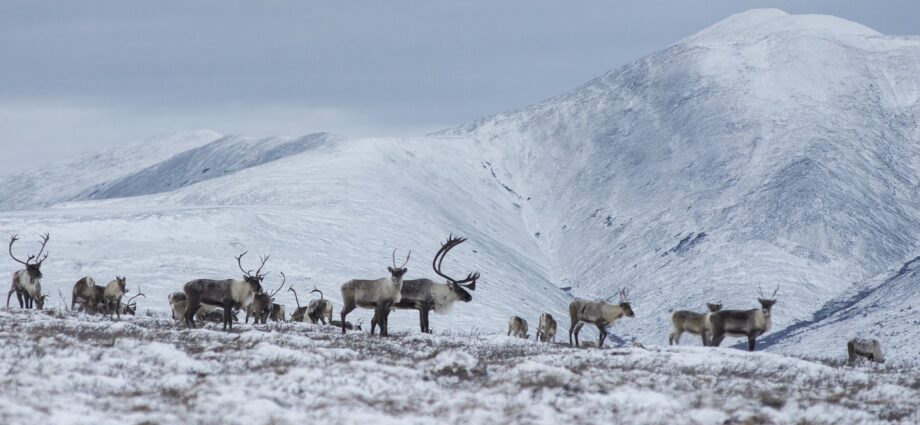
But in recent years, the herd has been declining: heavy snow has buried the lichen the caribou feed on, more calves are dying and the animals have remained on the Alaska side of their range.
Earlier this month, the Gwich’in Steering Committee, which represents Gwich’in communities across Alaska and Canada, updated its 2020 lawsuit to protect the Arctic National Wildlife Refuge’s coastal plain from drilling after the Trump administration decided in October 2025 to reopen parts of the refuge to new oil and gas development.
The revised lawsuit, approved by the US District Court in Alaska on Jan. 23, challenges the 2025 decision by the US Department of the Interior to bring back an earlier leasing program and restore seven oil and gas leases, held by Alaska’s state development agency. Those leases cover more than 145,000 hectares and were originally brought in 2021 but later cancelledin 2023 under the Biden administration.
The Gwich’in, alongside twelve environmental groups, are asking the court to cancel both the leasing program and the state’s leases, as the area is home to the Porcupine caribou herd, whose calving grounds are central to Gwich’in culture and food security.

According to figures released by the Alaska Department of Fish and Game on Jan. 7, the herd has declined from 218,000 in 2017 to 143,000 in 2025.

Many Gwich’in communities on both sides of the border rely on those caribou for food, tradition and culture. “There’s no borders for us,” said Kristen Moreland, executive director of the Gwich’in Steering Committee, who is based in Fairbanks, Alaska. “The Porcupine caribou herd does not know there’s a border — that’s how we are fighting this together.”
The lawsuit dates back to August 2020, when the US government first approved oil leasing in the Arctic refuge’s coastal plain. That area was originally protected under the 1980 Alaska National Interest Lands Conservation Act (ANILCA) of 1980, meant to safeguard wildlife and Indigenous rights. But a 2017 US tax and budget law passed during Trump’s first term tucked in a provision requiring oil lease sales there, setting the stage for drilling.
Their lawsuit claims the government violated multiple federal statutes, including the ANILCA, the National Wildlife Refuge System Administration Act, the National Environmental Policy Act, the Wilderness Act and the Endangered Species Act.
“We’re not seeing compliance,” Frost said. “If they’re not complying with their own rules of law, that they’ve themselves designed … The only way of forcing that is by way of a lawsuit. It’ll stall things for a bit.”
The Gwich’in Steering Committee has equal Canadian and Alaska representation, including two members appointed by the Vuntut Gwitchin First Nation.

The sacred land in changing climate
The Gwich’in Steering Committee traces its origins to 1988, when Elders from across the Gwich’in Nation — spanning Alaska, northern Yukon and the Northwest Territories — convened for the first time in more than a century to counter threats to their sacred Coastal Plain. The area is known in Gwich’in as “The Sacred Place Where Life Begins,” Moreland said.
The vast stretch of tundra along Alaska’s northern coast is also home to more than 200 species of migratory birds, as well as polar bears and other Arctic wildlife. Moreland said for the Gwich’in people, who have lived alongside this landscape for generations, any roads, drilling or industrial development would disturb the fragile ecosystem and permanently alter the balance between the land, the animals and their way of life.
“We still have ceremonies that surround our caribou,” she said. “We have teachings from our ancestors that are still in play to this day — we still use the tools [made from] every part of the caribou for clothing, beadwork, the hide for slippers and hats to keep warm.”

Frost said that climate change and habitat disruption are compounding the long-term pressures her community has been warning about for decades. “Last year, for the first time in our history, we observed and saw 187 per cent more snowpack than we have ever seen,” she said.
The heavy snow caused flooding and freshet runoff, making it harder for animals to reach their food sources. Unlike moose, which feed on leaves and branches, caribou rely on lichen and other ground vegetation — meaning they must dig through the deep snow to eat, she added.

With temperatures dropping to -50 C for weeks at a time, the extreme cold has further compromised animal survival rates. “The animals are moving, and it affects the food source on the table. We haven’t seen caribou in our community in a very long time.”

Climate change has also disrupted other traditional food sources, such as salmon, leaving Old Crow unable to afford or replace them with store-bought alternatives. “What do you rely on?” Frost said. “We’re not a tribe that can go to the store and just buy a bunch of beefsteaks. One, it’s not in our diet — but we can’t afford it also.”
Vuntut Gwitchin pays some of the highest food prices in Canada while also receiving the lowest federal subsidies under Ottawa’s Nutrition North program, said Frost, who is also former Liberal MLA and cabinet minister for the riding of Vuntut Gwitchin in the Yukon.
For Frost, the debate over the Arctic Refuge and the Porcupine caribou herd is inseparable from the survival of her people. The herd “has been part of our way of life for as long as we can remember,” she said, noting that damage to its habitat would have lasting effects on the health, culture and well-being of Gwich’in communities. She said the Gwich’in are seeking dialogue and collaboration. “We’re not standing against the administration,” Frost said. “We’re just trying to stand up for our rights and talk about policy directives that might be compromising our way of life.”

Moreland said she ultimately wants permanent protection for the Coastal Plain of the Arctic National Wildlife Refuge. Their legal challenge would stop industrial development including roads, seismic testing and drilling forever, protecting the Porcupine caribou herd’s health and their migratory route.
“We’ve been fighting for 40 years for this,” Moreland said. “[Right now] we are trying to slow them down in every area, we’re trying to stop it … there’s way more at stake than anyone ever knows.”
Frost said her childhood revolved around fishing, hunting and preparing for the seasons together as families — a way of life that she hopes will endure, even as the Arctic warms, so it can be passed on to future generations.
She described the late January sun rising over the frozen river in a burst of color, the light spreading across the snow. “We see this all the time in the North. It shows why we stay here — because of the beauty, the quiet, the life around us,” she said. “We have to keep our sights on the environment .. it’s changing so rapidly in front of us.”

Subscribe to our newsletter.
Sonal Gupta / Local Journalism Initiative / Canada’s National Observer.
