

January 11, 2026
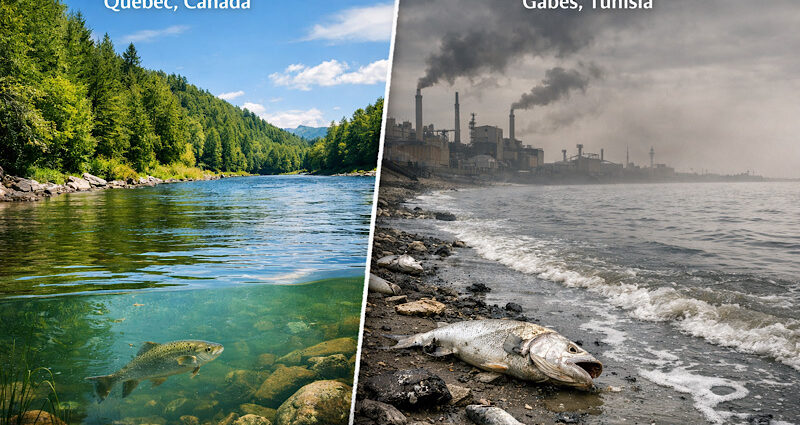
In January 2026, a court in Quebec, Canada, fined a chemical company $1.35 million for repeatedly discharging a harmful substance into the Rivière du Lièvre.
The incidents occurred in 2019. An investigation followed. Charges were laid. Guilty pleas were entered. Penalties were enforced. The case closed.
The river remains.
The law spoke.
The system acted.
On the southern coast of Tunisia, in Gabes, another story continues — without verdicts, without closure, without relief.
A Timeline That Ends — and One That Doesn’t
In Quebec, the discharge occurred over a very short period of time.
In Gabes, industrial pollution has lasted decades.
Every day, thousands of tons of phosphogypsum waste pour into the Mediterranean. The waste carries radioactive and toxic elements. This is not accidental. It is routine. It is sanctioned. It is ongoing.
The Gulf of Gabes, once one of the Mediterranean’s richest marine ecosystems, has been transformed into a grey, lifeless expanse. Fish vanish, biodiversity collapses, the sea itself changes colour.
One case produced court dates.
The other produced funerals.
Origins Matter
The industrial system poisoning Gabes did not appear by chance. It was established under French colonial rule, built to extract phosphate for foreign markets, supported by railways and ports designed for export, not for local life.
After independence, the structure remained. What was once imposed by force became policy, debt, and economic dependency. The logic never changed — only the flag.
Extraction continued. Waste stayed.
Enforcement as a Measure of Value
In Quebec, the case led to enforcement under federal environmental law. Investigators intervened. Courts enforced the Fisheries Act. Corporate responsibility was acknowledged. Accountability was made public.
In Gabes, environmental harm is admitted at times — even at the highest levels — yet discharges continue uninterrupted. Announcements are made. Promises repeated. Production targets rise.
The difference is not technical capacity.
It is priority.
When Pollution Becomes “Necessary”
In one place, pollution is treated as a violation.
In another, it is treated as a condition of survival.
Phosphate is framed as essential to Tunisia’s economy, even as it erodes the health of entire communities. Jobs are offered as justification. Silence becomes compulsory. Protest is met with repression.
Economic necessity, once accepted, becomes a shield — not for people, but for industry.
Visibility Changes Outcomes
The Quebec case was reported, followed, and concluded. Names were published. Penalties announced. Funds allocated for environmental repair.
Gabes appears briefly in headlines — usually after explosions, mass poisonings, or protests — and then fades. The pollution never fades. Only the attention does.
Environmental disasters persist not because they are complex.
They persist because they are allowed to remain unresolved.

Two Waters, One Question
The Rivière du Lièvre flows into the Ottawa River.
The Gulf of Gabes opens into the Mediterranean.
Both are waters shared by many.
Only one receives consistent protection.
The comparison does not accuse.
It simply observes.
If environmental harm can be investigated, prosecuted, and punished in one place, its permanence elsewhere is not a mystery — it is a decision.
Subscribe to our newsletter.
Gabes does not ask for sympathy.
It asks the question only time will answer:
Why did one pollution case end — while another was permitted to become a way of life?
